
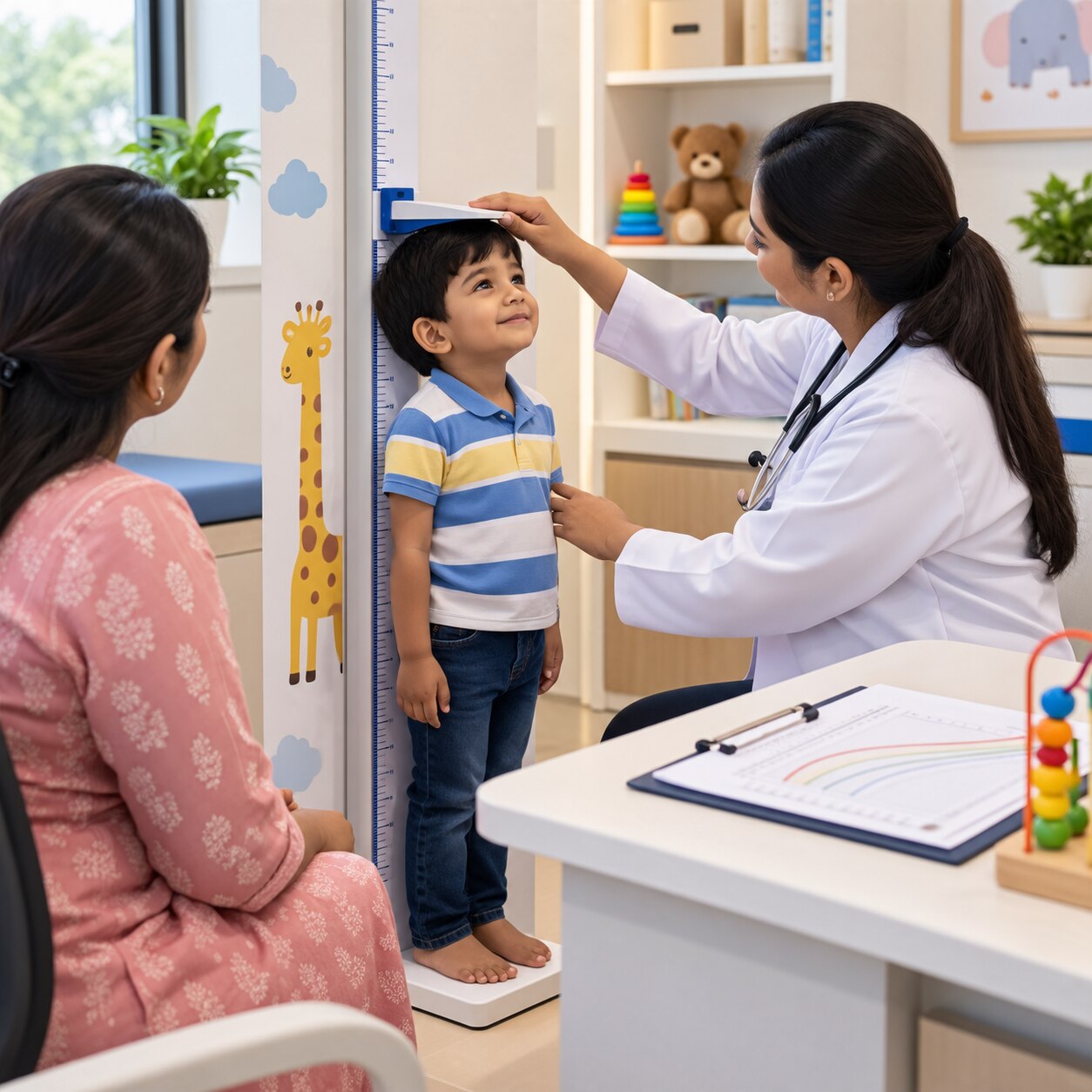
A useful child growth appointment measures more than weight and interprets the child’s pattern over time alongside nutrition, development and medical history. You will be able to compare local appointment options, ask the right booking questions and prepare records that help the clinician decide whether routine monitoring, specialist review or urgent care is needed.
Key takeaways
- A complete assessment checks height, weight, BMI, head circumference, and body proportions.
- Clinicians compare measurements with age- and sex-based growth charts over time.
- Take previous records, vaccination details, medicines, and your questions to the appointment.
- Book a paediatric consultation when growth changes, developmental concerns, or nutrition issues persist.
What should a complete child growth assessment measure?
A complete growth assessment measures more than weight. It checks whether a child is growing proportionately, explores nutrition and health factors, and compares findings with the correct age- and sex-based growth standards.
Expect these measurements and clinical information:
- Weight, recorded with the child lightly clothed
- Recumbent length for children under 2 years
- Standing height for older children
- Head circumference for infants and young children
- BMI-for-age when height and weight allow it
- Birth weight, gestational age and early feeding history
- Current diet, appetite, feeding difficulties and usual meal pattern
- Illnesses, medicines, sleep, activity and bowel symptoms
- Family heights, growth patterns and the timing of puberty
WHO standards include length or height-for-age, weight-for-age, weight-for-length or height, BMI-for-age and head circumference. A weight-only check can miss short stature, disproportionate growth or abnormal head growth.
For child growth for assessment Baner in Pune, take previous growth records, discharge summaries and medication lists if available. Do not start high-calorie supplements without clinical advice: they can worsen excess weight or delay diagnosis of malabsorption, chronic disease or an endocrine problem. The plan should follow the child’s measurements, diet history and examination findings.
How do clinicians decide whether a growth pattern needs review?
The plotted pattern matters more than a single percentile. A child who remains near the 10th percentile for height and grows at a steady rate is not automatically unwell; a child who drops from the 50th to the 10th percentile needs review. For children aged 0–5 years, clinicians usually use WHO Child Growth Standards.
Older children are assessed with height-for-age and BMI-for-age references, not adult BMI cut-offs.
A meaningful change requires reliable measurements: a calibrated scale, stadiometer or length board, minimal clothing, correct positioning and the measurement date. Small technique errors can create a false percentile drop. Review becomes more important when:
- Height velocity is slower than expected over time.
- Weight falls before height, suggesting inadequate intake or illness.
- The child crosses major percentile lines, or height is far below the family pattern.
- Growth changes accompany persistent diarrhoea, vomiting, fatigue, pain or delayed puberty.
Possible causes include feeding difficulty, insufficient dietary intake, malabsorption such as coeliac disease, chronic inflammatory or kidney disease, and hormone problems such as hypothyroidism or growth hormone deficiency. Family short stature and later puberty can also explain a healthy pattern, but the history must support that interpretation.
High-calorie supplements are not a default treatment; they can worsen excess weight or delay diagnosis.
When choosing a pediatric growth clinic in Pune, ask whether the clinician can arrange paediatric endocrinology review and laboratory or imaging referrals for poor height velocity, unusual puberty or suspected hormonal disease.
What does a child development assessment include?
A complete assessment checks skills across development, not just whether a child walks or talks. It combines a formal developmental screening tool with clinical history, observation, physical examination, and review of hearing, vision, behaviour, learning, and daily functioning.
Ask whether the appointment covers:
- Gross motor skills, such as sitting, walking, running, balance, and coordination.
- Fine motor skills, including grasping, drawing, writing, feeding, and using utensils.
- Language and communication: understanding instructions, using words, gestures, conversation, and clarity of speech.
- Social-emotional skills, play, eye contact, interaction, self-regulation, and behaviour.
- Problem-solving and cognitive skills, including attention, memory, learning, and age-appropriate concepts.
- Hearing and vision screening, sleep, feeding, toileting, school performance, and functioning at home.
- Birth history, including gestational age and birth weight, plus illnesses, medicines, family history, and previous reports.
Developmental surveillance at routine visits is not the same as standardized screening. The American Academy of Pediatrics recommends standardized screening at 9, 18, and 30 months, with autism-specific screening at 18 and 24 months, or whenever a concern arises. Ask what tool is used, who interprets it, and what happens after an abnormal result.
When arranging a child development assessment baner, confirm whether the clinic provides only screening or also offers speech, occupational, psychological, or autism diagnostic referrals. A paediatric visit can coordinate the next step without providing every specialist test on the same day.
Which appointment should you book in Baner or Balewadi?
Book a routine outpatient paediatric appointment for a planned child growth checkup Balewadi, including concerns about height, weight, feeding, sleep, development or school performance.
| Option | What it means | When it applies |
|---|---|---|
| Routine outpatient paediatric appointment | Growth measurements, history, examination and developmental screening, with follow-up arranged | The child is alert and stable, but growth, nutrition, development or puberty needs review |
| Specialist referral | Assessment by paediatric endocrinology, developmental paediatrics, speech therapy, occupational therapy or psychology | There is short stature, slow height gain, delayed or early puberty, suspected hormonal disease, or a persistent speech, behaviour or learning concern |
| Emergency care | Immediate assessment in an emergency department | The child has breathing difficulty, blue lips, unresponsiveness, a seizure, severe dehydration, heavy bleeding or sudden deterioration |
Ask the clinic whether infants, older children and adolescents are seen, and whether staff measure length or height, weight and head circumference on site. Confirm whether formal developmental screening is included; a general visit can identify a concern without providing same-day autism, speech or psychological testing.
For suspected endocrine problems, ask whether the clinician can arrange paediatric endocrinology review, blood tests or imaging. Dr Pooja Gire Pediatrician Baner, Balewadi, Pune can be considered for an outpatient assessment when your child is stable and needs growth or development review rather than emergency treatment.
Take previous measurements and records so the clinician can decide whether referral is needed.
What should you take to the appointment and ask about follow-up?
Take previous height, weight and head-circumference records, birth records, discharge summaries, medication lists, and school or therapy reports.
A search for child growth for assessment Baner in Pune becomes more useful when you also bring the child’s birth weight, gestational age, feeding history, typical diet, illnesses, medicines, sleep, activity, bowel symptoms, family heights and parents’ puberty timing.
Prepare these details before you arrive:
- Write down when you first noticed poor weight gain, short stature, weight change, delayed skills, speech difficulty, behaviour change or learning problems.
- Record a typical day of meals, milk, snacks and supplements. Do not start high-calorie products without advice; they can worsen excess weight or delay investigation of malabsorption, chronic disease or endocrine problems.
- Ask which measurements will be repeated and when the next growth-chart review should occur.
| Option | What to clarify | Follow-up question |
|---|---|---|
| Routine paediatric visit | Whether formal developmental screening is included | What happens if screening identifies a concern? |
| Development concern | Whether speech, occupational, psychological or autism assessment is available | Which referral is needed, and how soon? |
| Growth or puberty concern | Whether paediatric endocrinology review and laboratory or imaging referrals can be arranged | Which findings trigger specialist review? |
For a child development assessment baner appointment, ask whether results are documented and shared with school or therapists. Confirm the review date, warning signs that require earlier contact, and whether urgent symptoms belong in emergency care rather than routine follow-up.
Frequently asked questions
What should a complete child growth assessment measure?
It measures weight, length or height, head circumference when appropriate, BMI, body proportions, nutrition, and relevant health factors using age- and sex-based growth standards.
How do clinicians decide whether a growth pattern needs review?
They review measurements over time, compare them with the correct growth charts, assess proportionality, and investigate changes in growth or associated symptoms.
What does a child development assessment include?
It reviews age-appropriate motor, language, social, emotional, cognitive, and self-care skills, along with concerns reported by parents or caregivers.
Which appointment should you book in Baner or Balewadi?
Book a paediatric consultation for a routine child growth checkup, growth change, nutrition concern, or developmental question. Ask for a child development assessment when milestones need detailed review.
What should you take to the appointment and ask about follow-up?
Take previous growth records, vaccination details, medication information, school or therapy reports, and a list of concerns. Ask when to repeat measurements and which symptoms require earlier review.
Keywords