
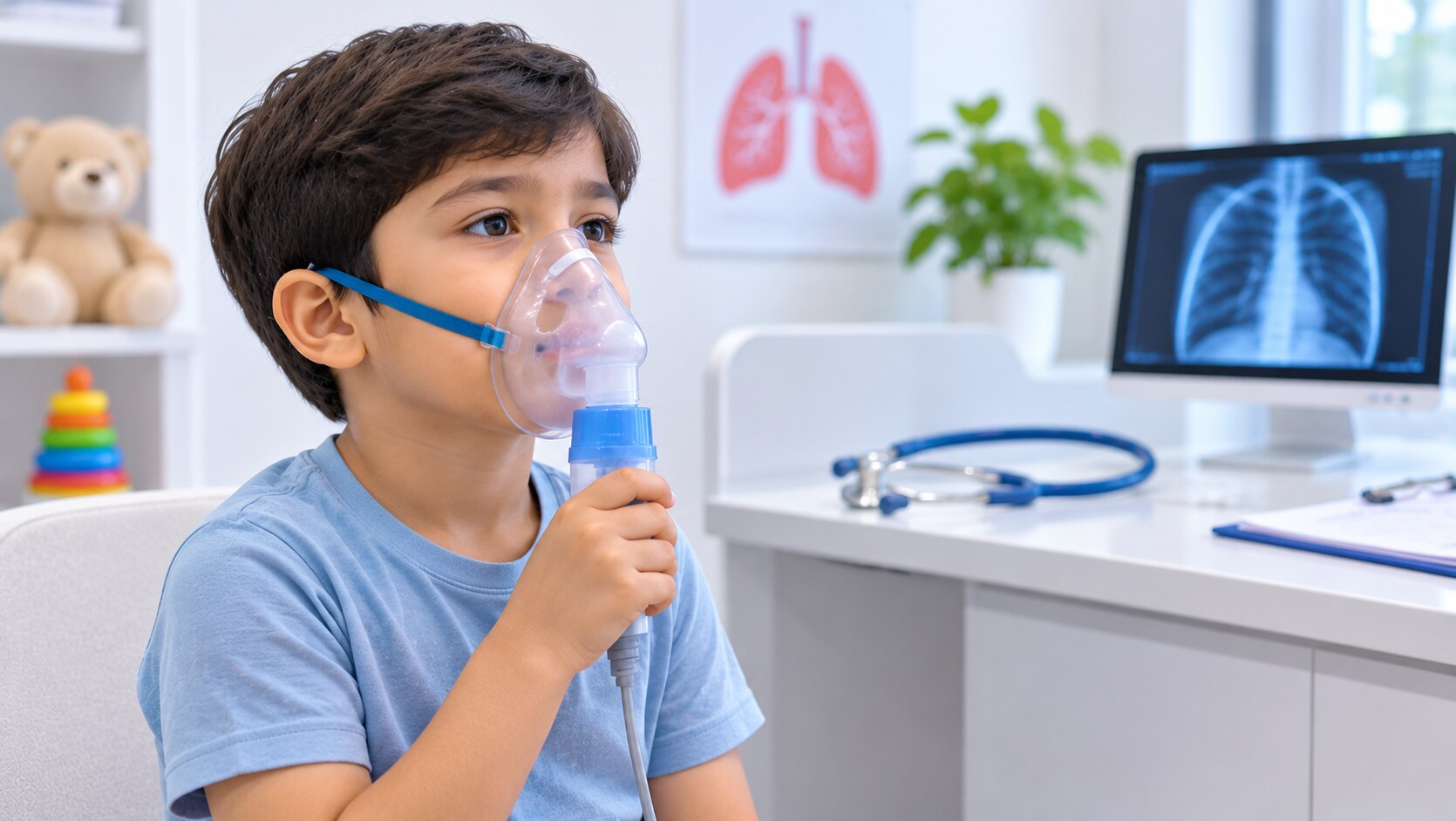
Dry heat, monsoon dampness, traffic pollution, dust and sudden temperature changes can expose a child to different breathing triggers across Pune. By the end, you will know how to identify the likely pattern, reduce exposure at home and outdoors, use prescribed treatment safely, and recognise when a child needs same-day or emergency care.
Key takeaways
- Seek urgent care for severe breathlessness, blue lips, confusion or inability to speak.
- Keep windows closed during visible pollution, dust storms and thunderstorm outflows.
- Control dampness, mould, dust mites and smoke during Pune’s monsoon.
- Arrange a pediatric review when seasonal cough or wheeze keeps returning.
Which Pune weather conditions can trigger breathing symptoms?
Cold or dry air, humidity, thunderstorms, pollen, mould, dust and traffic pollution can trigger wheezing, cough or chest tightness in a child with asthma or sensitive airways; weather does not create asthma. Dry periods lift dust and fine particles, while monsoon dampness encourages indoor mould and dust mites.
Heavy rain does not automatically clean the air: thunderstorms can break pollen and fungal material into smaller particles that travel deeper into the lungs.
| Pattern | Clues that support it |
|---|---|
| Allergic rhinitis | Blocked or runny nose, sneezing and itchy, watery eyes, often after pollen or dust exposure |
| Viral infection | Fever, sore throat, sick contacts and symptoms lasting several days |
| Asthma or airway hyper-reactivity | Recurring night cough, exercise-related symptoms and repeated episodes without fever |
| Post-viral cough | Cough that continues after the infection improves, without a new fever or repeated wheeze |
For weather respiratory problems, children in Pune need an exposure record rather than an assumption that rain or heat is responsible. Record:
- Date, weather, location and activity
- Fever, pollution conditions and nearby construction dust or a busy road
- Damp walls, mould, pets, indoor smoke or poor ventilation
- Medication given and the child’s response
This pattern can show whether symptoms follow weather itself or a local exposure in Baner, Balewadi or elsewhere. Repeated wheezing, night cough or exercise limitation deserves pediatric assessment.
How can you tell mild weather-related cough from breathing difficulty?
A mild throat-clearing cough with normal play, eating, speech and skin colour is different from breathing difficulty. Watch for wheezing, chest tightness, a persistent cough, fast breathing, nasal flaring, or chest indrawing between or below the ribs.
Age changes how distress appears:
- Infants may struggle to feed, pause during feeds, grunt, produce fewer wet nappies or become unusually sleepy.
- Toddlers may stop playing, cling to a parent, breathe noisily or use their tummy muscles to breathe.
- School-age children may say they cannot run, speak in full sentences or take a deep breath.
- Adolescents may describe chest tightness, air hunger or a sudden drop in exercise tolerance, even when outward signs seem slight.
Arrange same-day pediatric assessment when symptoms recur, disturb sleep, limit activity, follow dust or pollution exposure, or do not settle with the child’s prescribed plan. Track child breathing symptoms during weather changes in Baner by noting the date, location, activity, fever, air quality, medication and response.
Seek emergency care immediately if the child:
- Struggles to speak, feed or drink because of breathlessness
- Has severe chest retractions or nasal flaring
- Develops blue or grey lips
- Becomes confused or unusually drowsy
- Shows no improvement after the prescribed reliever
Do not wait for fever, rain to stop or steam or another home remedy to work. Asthma attacks can occur without fever.
What should families change at home and outdoors when weather shifts?
1. Check a local air-quality reading before outdoor exercise, but treat it as guidance rather than a diagnosis. When fine-particle pollution is high, keep your child away from busy roads, reduce strenuous activity, close windows during peak pollution, and use filtration or a cleaner indoor room if available.
During a severe thunderstorm, keep windows closed and follow the asthma action plan.
2. Control dampness indoors. Repair leaks, dry wet bedding and clothing promptly, remove visible mould safely, and keep indoor relative humidity below 50%. Excessive humidifier use can worsen mould and dust-mite exposure.
Ventilate rooms when outdoor air is cleaner, and never expose a child to tobacco smoke, incense, mosquito coils, wood, charcoal or poorly ventilated cooking fumes.
3. Avoid outdoor exercise when your child is wheezing, breathing fast, has chest tightness or needs repeated reliever doses. After symptoms improve, restart with easy activity and stop if cough or breathlessness returns; use only the pre-exercise medicine prescribed by the clinician. Carry prescribed rescue medication and a spacer when travelling or attending school.
4. Ordinary viral symptoms do not require unnecessary isolation from school. Fever, marked fatigue, uncontrolled cough or breathing difficulty requires staying home and medical advice. Weather changes do not diagnose a child for breathing problems, so discuss recurring symptoms with a pediatrician in Pune and record exposures, activity, medicines and response.
Which common responses to weather-related breathing problems can cause harm?
Feeling better is not a reason to stop a prescribed inhaled corticosteroid, and a season change does not cancel it. A controller reduces airway inflammation and attack risk; a short-acting reliever treats immediate symptoms. They are not interchangeable. Use the medicine, dose and frequency written in the child’s asthma action plan.
| Medicine or approach | What it does | What to remember |
|---|---|---|
| Inhaled corticosteroid | Controls airway inflammation | Continue exactly as prescribed, even when the child feels well |
| Short-acting reliever | Relieves acute wheeze or breathlessness | Use the written dose with a correctly fitted spacer |
| Nebulizer | Delivers inhaled medicine as a mist | It is not automatically stronger; the clinician decides when it is needed |
For weather respiratory problems in children in Pune, do not choose a nebulizer because it sounds more powerful. During an acute episode, a reliever inhaler with a correctly fitted spacer is often more dependable. Ask the clinician to demonstrate the spacer, then have your child show the technique back.
Do not give antibiotics for every cough after rain or a temperature change; they do not treat asthma, allergy or most viral infections. Steam does not open narrowed airways and can cause scald burns. Warm fluids may soothe a throat but cannot replace prescribed reliever treatment.
Keep mosquito coils, incense and smoking away from the child, including in cars and other rooms, because smoke travels through indoor air. If the reliever is needed more often than the plan permits, or symptoms return soon after treatment, seek medical advice instead of repeating home remedies.
When does a child need a pediatric review for recurring seasonal symptoms?
Arrange a review when wheeze occurs in particular weather, after exercise, at night, around dust or mould, or during repeated infections. A child who wheezes only in one season still needs assessment: intermittent asthma, viral wheeze, allergy, foreign-body aspiration, and less common heart or lung conditions can look similar.
Ask the pediatrician to check:
- The symptom diary, including date, weather, location, activity, fever, air-quality conditions, medication and response.
- Construction dust, traffic, dampness, visible mould, pets, tobacco smoke and poor ventilation.
- Eczema or allergy history, vaccination status and growth.
- Adherence to prescribed treatment and inhaler-spacer technique, with a demonstration and teach-back.
- Whether spirometry is suitable. It can help children who perform the test reliably; younger children often need diagnosis based on history and repeated examinations.
Ask for a written asthma action plan naming the daily controller, reliever, dose, warning signs and escalation steps. Families looking for a pediatrician for seasonal breathing problems Balewadi can discuss recurring patterns and diagnostic uncertainty with Dr Pooja Gire Pediatrician Baner, Balewadi, Pune.
The aim is not to blame every cough on Pune weather. Identifying the actual trigger protects the airways, supports safe school and play, and helps you act early when breathing becomes unsafe.
Related services
Acute and Chronic Childhood illness’s Clinic Acute and Chronic Childhood illness’s Clinic in Baner, Balewadi, Pune Dr Pooja Gire – Best Acute & Chronic Childhood Illness Clinic in Pune. View service → |
Child Fever, Cough Cold infections and Allergy Clinic Child Fever, Cough Cold infections and Allergy Clinic in Baner, Balewadi, Pune Dr Pooja Gire – Best Child Fever, Cough, Cold, Infection & Allergy Clinic in Pune Bloom Women & Child Clinic, led by Dr Pooja Gire, is a trusted... View service → |
Frequently asked questions
Which Pune weather conditions can trigger breathing symptoms in children?
Cold or dry air, high humidity, thunderstorms, pollen, mould, dust, dust mites and traffic pollution can trigger cough, wheeze or chest tightness. Weather does not cause asthma, but it can irritate sensitive airways.
How can parents tell a mild weather-related cough from breathing difficulty?
A mild cough should not change a child’s breathing effort, speech, colour or activity. Seek urgent care if the child breathes fast, pulls in the ribs or neck, struggles to speak, has blue lips, becomes unusually drowsy or does not improve with their prescribed reliever plan.
What should families change at home and outdoors when Pune weather shifts?
Reduce exposure to smoke, incense, traffic pollution and visible dust. Keep indoor humidity controlled, repair leaks, remove mould safely, wash bedding regularly and keep windows closed during dust events or thunderstorms. Follow the child’s written asthma or wheeze action plan.
Which responses to weather-related breathing problems can cause harm?
Do not force steam inhalation, use leftover antibiotics, share another child’s inhaler or delay care while waiting for weather to improve. Use only medicines prescribed for that child, with the correct spacer and technique.
When does a child need a pediatric review for recurring seasonal breathing symptoms?
Book a review when cough, wheeze or chest tightness returns with each monsoon, winter, dust event or outdoor exposure; disrupts sleep or activity; needs repeated reliever doses; or follows no clear action plan. A pediatrician can assess asthma, allergies, infection and other causes.
Related services
Pediatrician Child Specialist in Baner, Balewadi, Pune Dr Pooja Gire – Best Pediatrician, Child Doctor & Child Specialist in Pune. View service → |
Pediatric Emergency Services and IPD Services at Manipal Hospital Pediatric Emergency Services and IPD Services at Manipal Hospital Dr Pooja Gire is a trusted Pediatric Doctor and Pediatric Intensivist in Pune, providing comprehensive medical care for newborns, infants, children,... View service → |
Keywords