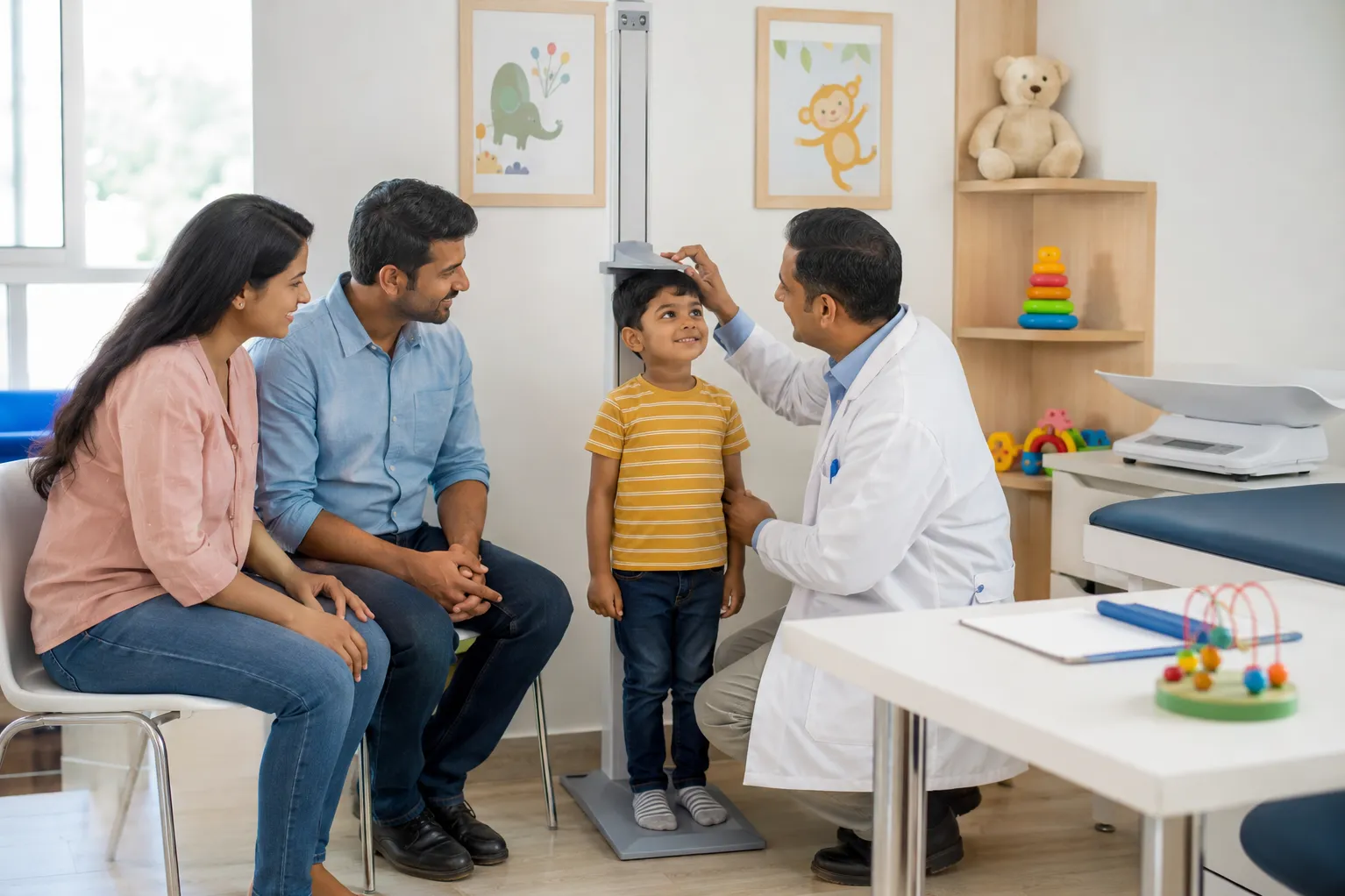
Children do not all grow at exactly the same speed. Some speak earlier, some gain height quickly, and others take longer to reach particular developmental milestones. However, parents may still wonder whether a change is part of normal individual variation or deserves closer evaluation at a Child Growth and Development Clinic in Baner.
Growth and development are related, but they describe different aspects of childhood health.
Growth and Development Are Not the Same
Growth generally refers to measurable physical changes such as height, weight, and head circumference in younger children.
Development describes how children gradually acquire abilities in areas such as:
- Movement
- Speech and language
- Social interaction
- Learning
- Fine motor skills
- Problem-solving
- Everyday independence
A child can have appropriate physical growth while still requiring assessment of a developmental concern, or vice versa.
Why Growth Charts Are Useful
Parents sometimes become worried because their child is shorter or lighter than another child of the same age.
A single comparison rarely tells the whole story.
Pediatricians typically look at growth measurements over time. The pattern can be more informative than one number because it shows whether the child is following a reasonably consistent trajectory.
If there is a significant change in that pattern, the pediatrician may consider factors such as nutrition, illness history, feeding difficulties, family growth patterns, or other clinical findings.
Developmental Milestones Provide Reference Points
Milestones help pediatricians and parents understand how skills generally emerge during childhood.
They are not intended to turn development into a competition.
During routine pediatric visits, parents may be asked whether a child responds to sounds, makes eye contact, sits, walks, uses words, follows instructions, interacts socially, or performs age-appropriate tasks.
If parents notice that a previously acquired ability has been lost, that information is particularly important to share promptly.
What Should Parents Observe at Home?
Parents spend far more time with their children than clinicians do, so everyday observations can provide valuable information.
Consider noting:
- Changes in appetite
- Feeding difficulties
- Physical activity
- Speech progress
- Interaction with family members
- School performance
- Sleep
- Behaviour
- Ability to perform everyday tasks
Videos of specific movements or behaviours may sometimes help explain a concern that does not appear during a clinic visit.
Early Discussion Is Useful
Parents do not need to diagnose a developmental condition before asking a pediatrician about their observations.
If something about the child's progress seems different, discussing it during a routine consultation allows the pediatrician to assess the broader context and decide whether monitoring, additional evaluation, or referral is appropriate.
For families in Baner and the wider Pune region of Maharashtra, routine growth and developmental monitoring can become part of scheduled pediatric care.
Dr. Pooja Gire Pediatrician supports parents with age-appropriate child health assessment, including growth and developmental monitoring.
The goal is not to compare children unnecessarily. It is to understand each child's individual pattern, recognise meaningful changes, and give parents practical guidance about what should be monitored as their child grows.
Keywords